
Ultra-Trail Snowdonia - May 2026
“Stefan: My hands are flat against cold rock. The world drops away on both sides, and I can see exactly how far down it goes… eighty kilometres in the legs. No margin. James is already gone, somewhere ahead, Gavin and I still out here edging across endless rock..”.

By even the gnarly standards of trail running, the Ultra-Trail Snowdonia (UTS) is a beast. It is widely described by runners, racers, and the media as the toughest, most brutal mountain ultramarathon in the UK. It occupies a premier fixture on the global
UTMB World Series calendar. Centred around Llanberis and the rugged terrain of Eryri (Snowdonia) National Park, the event this year featured five primary distances - 25k, 50k, 80K, 100k, and the flagship 100-mile (165km).
Sample this: you are greeted by a 900-meter elevation curveball straight out of the gates. That is followed by some classic quad-destroying descents. Then, if you still have some more life left in you, prepare to get that sucked out of you by the Welsh bogs. And if the weather throws you a googly, then you are in for a treat.
Mark - In UTS, there is a degree of urgency to everything, as you know that the longer you're out in the mountains, the higher the chance of DNF-ing, not just from cut-off times (which are generous), but from physical exhaustion and being unable to keep food down. The first niggle started in my feet, which felt like they were swimming around in the toe box area of my shoes, climbing the first peak. However, going through the first of many bogs, this stopped being so much of a problem; somehow, the water swelled the toe socks to fill the whole shoe. This was quite good, as it was a rainy day; we were never far from a bog to keep the shoes cool and snug. Not conventional wisdom perhaps, but somehow, in the mountains, whatever works, works. There is no room for pedantry; making it up as you go is the best strategy.

A few days ago, our WhatsApp group was buzzing about the race. The 100 km route, which Gavin, Francois, Mark, James and Stefan were doing had its route changed yet again in the days leading up to the race. Liz and Saikat were doing the 50K route. Discussions in the final few hours focused on nutrition strategies and the ever-changing weather. Driving up to Llanberis on the day before the race was picture perfect; you could see the mountain tops, the air was crisp, and the sky was blue. The race village had a festival vibe to it.
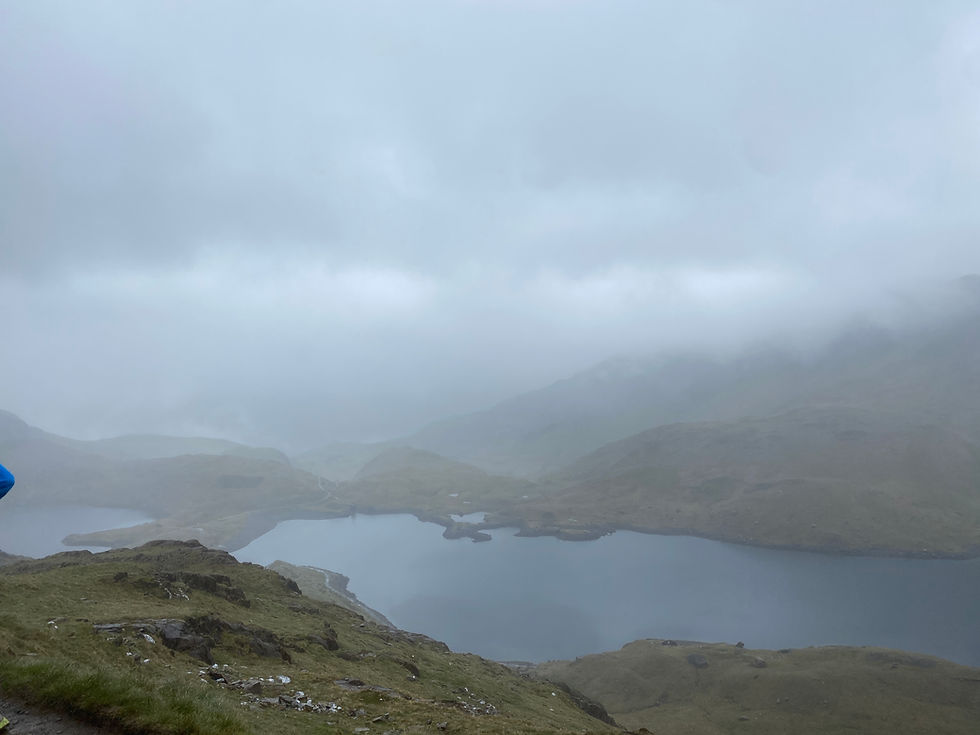
The relentless cold and heavy rain descended on Saturday morning, obscuring the summit views and dropping visibility to a few meters ahead. The Welsh Gods had decided to bring the weather to the party and this was going to be the mise- en- scene for the weekend. But our spirits were high. We had done some recces of this route, Liz had done the 50K last year. We felt prepared. The 100 km gang set out at 5:30 am, while the 50 kms duo started at 8:45 am. We were toying with the idea of catching up over a late breakfast on Sunday before setting off home.
“Gavin - Checkpoint 6 at 81km. This is where it got serious. There was lots of excitement about route changes in the run-up to the 100k, and the bit from 80km was a "new bit" kindly added to the race 3 weeks beforehand, giving us an extra 1.2km of elevation to enjoy, so no one could feel they'd been cheated out of a solid mountain experience. So we'd have 1.2km of climbing over another 14km, and coast into the penultimate checkpoint ready for a nice jog into Llanberis. Easy does it. 7 hours 30 minutes later.
SEVEN HOURS AND THIRTY MINUTES. For 14km.
Hard to believe now, but that was near constant moving; there was no sitting down for 30 minutes to admire the sunrise. It was relentless and technical. James convinced us we'd done the hard bit, and as he was clearly keeping a quicker pace than Stefan and me, and at risk of cooling down, he set off ahead of us. So then it was just me and Stefan, and then we saw it. That "hard bit" was most definitely still to come, the Nantlle Ridge looming above us. For one of the rare occasions we had a clear view of where we were going, up, along a knife-edge, and then down (not exactly sure how or where). We were in too deep; there was no point bailing now, as it would take just as long to get back to the last checkpoint. So off we go. It's a bit of a blur. Overhangs, large boulders, wrong turns, doubling back, asking myself if I'm still able to make a sensible decision after 24 hours of moving and no sleep, whilst I adjust my feet, grab a rock, twist my body, extend my foot over a drop, push with my bodyweight and rebalance, again and again. Best case, a slip and some bruises, worst case, I'm not thinking about that. Keep moving..”
Trail running strips away the rigid monotony of pounding feet on asphalt into a deeply immersive dialogue with nature. Trail runners encounter a constant shifting landscape of twisted roots, jagged rocks, loose scree, mud, and, if you are lucky, bog. There is a lot of talk of ‘technical’ and ‘vert’. Elites like Kilian Jornet epitomise this relationship, viewing towering peaks as vertical playgrounds where human boundaries are tested. For us @UTS, supporting each other through some of the toughest conditions was the highlight.

“James - Forming a super nice little pack with Francois, Gavin and Stefan after 4-5 hours that then stuck together for almost the entire race. The camaraderie throughout -
sharing hours in terrible weather made the experience even better. Spirits remained high even through some of the very challenging sections in the night..”

“Liz - The highlight for me was seeing how everyone came together and supported each other - particularly the guys doing the 100k!”
On the best of days, climbing Snowdon is a feat. Doing that twice via different paths under time constraints is borderline madness. Within this sport exists a peculiar, almost masochistic love for hills that defies ordinary logic. This year’s race took some flak for a route change that runners felt robbed them of elevation gains, before organisers ultimately reversed the decision. The gruelling, lung-burning ascents are rewarded by panoramic views, followed by the adrenaline-fueled thrill of flying down technical descents.

When I was considering signing up in October, Francois sold me this one with the line,“ You will enjoy the views, and there are a bunch of us going”. For us, the highlights were the reccees, the chat and the incredible support on the trails. And the food chat (sorry, nutrition discussion). Baby bells, Coke, chicken pate, Marmite and butter on white bread, crisps, anything and everything is fair game. This sport is a gastronomic delight.
I will be back next year to finish the job, while some others are considering a repeat adventure. Stockholm Syndrome, anyone?
‘Stefan: Last aid station. Ten kilometres. Stones in shoes, time on the clock - irrelevant now. Snowdonia looked like it had no idea what it had just done to us. Llanberis appeared. People were cheering. Gavin and I crossed the line together, which felt right. Five started. Three finished. The mountain sorted us honestly. I don’t recommend the chilli. Others can confirm. Add thirty hours, ninety-nine kilometres, and a quantity of swearing I won’t put in writing - that’s the UTS 100K.

